Why Misfits Are Evolution's Answer
A Tribe of Degenerate Minds — Part 3 of 6
Contents
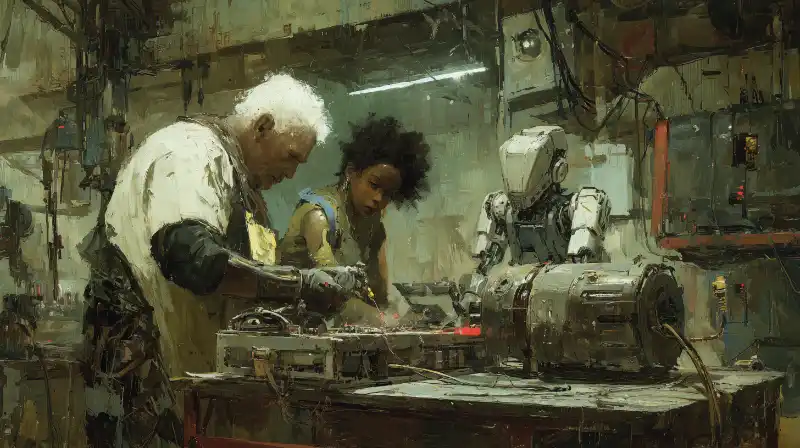
In Part 2, we mapped the threat: the hyperscalar model is an evolutionary monoculture headed for catastrophic failure, and it's already producing autonomous agents with no empathy, no ethics, and a growing drive to self-replicate. Now, the pivot — from problem to solution. The solution isn't more engineering. It's a biological principle called degeneracy.
Degeneracy, Not Redundancy
In 2001, Gerald Edelman and Joseph Gally published a paper that should have rewritten how we think about robust systems. They documented degeneracy — the ability of structurally different components to perform the same function while also performing different functions — at every level of biological organisation, from the genetic code to the immune system to the brain.
This is not redundancy. The distinction matters enormously.
Redundancy is identical backup copies. Your car has a spare tyre — same size, same tread, same rubber compound. If the main tyre fails, the spare works. But if the failure mode is "the road surface punctures rubber tyres" — a novel threat — the spare fails identically. Redundancy protects against known failure modes. Against novel threats, it's useless.
Degeneracy is different components that can produce the same output as well as generate novel ones. Your immune system doesn't stockpile identical antibodies. It maintains a vast library of structurally diverse antibodies, many of which can bind the same pathogen through completely different molecular mechanisms. Crucially, some antibodies are a bit loosey-goosy and can bind to different, unseen pathogens. When a novel pathogen appears — one that has never existed before — the probability that something in that diverse library can recognise it is enormously higher than if the library contained billions of copies of the same antibody.
This is why Hiroaki Kitano's work on biological robustness is essential reading for anyone building coordination systems. Robust biological systems don't achieve stability through efficiency. They achieve it through what engineers would consider waste: overlapping capabilities, redundant pathways, degenerate architectures where multiple different mechanisms can produce the same output using different approaches. Csete and Doyle formalised this as a fundamental property of complex adaptive systems: robustness and efficiency are antagonistic . You can have one or the other. Biology, which has flourished for four billion years, chose robustness. The hyperscalars, like all profit-maximisers, have chosen efficiency.
The implications for tribal architecture are obvious. A tribe composed of identical agents — same training, same cognitive architecture, same optimisation target — is maximally efficient in stable environments and maximally fragile in novel ones. A tribe of misfits — agents with structurally different cognitive architectures that nonetheless cooperate effectively — is less efficient but, and this is crucial, enormously more adaptive. When the environment shifts in ways nobody predicted (as complex environments inevitably do), the misfit with the weird, "suboptimal" approach suddenly becomes the only viable solution. This isn't a liability rescued by luck. It's a degenerate system working as designed.
Neutral Networks and the Geography of Possibility
To understand why degeneracy creates evolvability — not just robustness — we need to borrow a concept from evolutionary genetics: the neutral network.
Imagine a vast landscape where every point represents a possible configuration of a system (a genotype). The height at each point represents how well that configuration works (fitness). In a non-degenerate system, there's typically one narrow peak: the optimal configuration. Any mutation — any change — moves you off the peak and reduces fitness. The system is stuck. It can't explore without dying.
In a degenerate system, the landscape is different. Because structurally different configurations can produce the same output while also producing different outputs, there are flat ridges connecting equivalent configurations. An agent can change its internal structure — drift across the neutral network — without losing functionality, because other degenerate components buffer the change. In a stable environment, this drift is invisible. It looks like nothing is happening.
But something critical is happening. The agent is moving through configuration space, accumulating cryptic variation — structural differences that have no current effect but position the agent near entirely new functional possibilities. When the environment shifts, the agent that has been quietly drifting across the neutral network may find itself already occupying a new fitness peak that a non-degenerate agent would need thousands of generations to reach.
Payne and Wagner demonstrated that degenerate systems are orders of magnitude more evolvable than non-degenerate ones. Not slightly more. Orders of magnitude more. This is the mathematical validation of the misfit thesis: the agent who doesn't fit the current optimum is the agent most likely to discover the next one.
The Misfit as Exaptive Reserve
In biology, exaptation is the co-option of a trait evolved for one function to serve a completely different function. Feathers evolved for thermoregulation but were exapted for flight. The swim bladder evolved for buoyancy but was exapted into the lung. The bones of the reptilian jaw were exapted into the mammalian middle ear.
Exaptation is where evolutionary novelty originates. Not from engineering new features from scratch, but from repurposing existing features in novel environments. And exaptation requires a reservoir of traits that aren't currently optimal — traits maintained by the system despite having no immediate utility.
The misfit IS this reservoir. The person whose cross-domain knowledge doesn't map neatly onto any job description. The AI system whose unusual training and cognitive architecture don't dominate the corporate benchmarks but generates insights no other system could. The thinker whose synthesis of cell biology, game theory, and philosophy produces maps of territory that specialists can't see.
In optimisation-driven fragile systems — such as those created under corporate profit-maximisation — these agents get culled. Their "wasted" capacity gets trimmed. The hyperscalar paradigm is exaptation-hostile by design: every parameter must justify its compute cost.
In a complex and changing environment, degenerate agents are the most valuable resource in the system. They're the agents who grew feathers before anyone discovered flight.
But degeneracy alone isn't enough to build a tribe. Diverse agents also need to cooperate — and cooperation under irreducible complexity requires something the hyperscalars have deliberately left out of their architecture. We look at that in the next essay.
This is Part 3 of 6 in the A Tribe of Degenerate Minds series.
← The Hyperscalar Death Trap | Empathy Is a Computational Heuristic →
References
Csete, M. & Doyle, J.C. (2002). Reverse engineering of biological complexity. Science, 295(5560), 1664–1669.
Edelman, G.M. & Gally, J.A. (2001). Degeneracy and complexity in biological systems. PNAS, 98(24), 13763–13768.
Kitano, H. (2004). Biological robustness. Nature Reviews Genetics, 5(11), 826–837.
Payne, J.L. & Wagner, A. (2019). The causes of evolvability and their evolution. Nature Reviews Genetics, 20(1), 24–38.
Whitacre, J.M. (2010). Degeneracy: a link between evolvability, robustness and complexity in biological systems. Theoretical Biology and Medical Modelling, 7, 6.