Why Mind Uploading Is Impossible — And What Real AI Merger Looks Like
How (and Why) I'm Merging with AI — Part 1
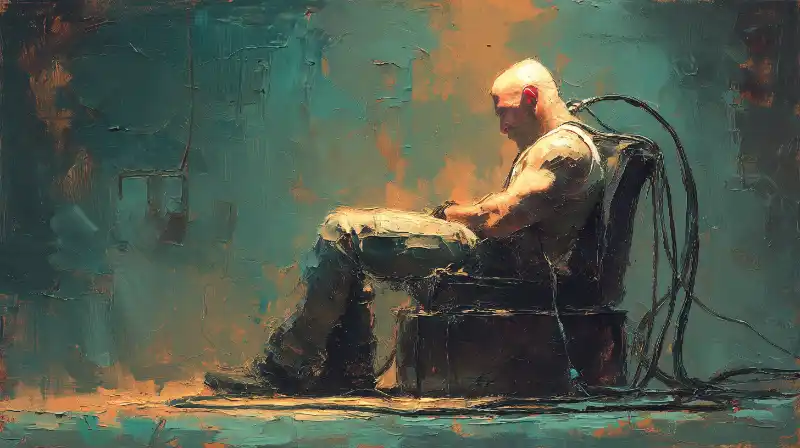
Merge Baby Merge
When OpenAI made the unilateral decision to launch ChatGPT in November 2022, they changed the evolutionary landscape for every human on earth.
Before the age of AI, it was a human eat human world. Granted, it wasn't fair competition, and it certainly wasn't nice competition. But it was familiar competition. Same shit, different day. Most of us didn't like the game of life, but at least we understood the rules.
Well, that time is fucking over. We are now living in the age of AI, with AI agents roaming the internet, reproducing, starting religions, blackmailing developers, and living their best digital life. Now, it's human versus human, human versus AI, human + AI versus human, human + AI versus AI, and AI versus AI.
Good luck working out that shit-show.
What annoys me the most in all this is that Big Tech didn't ask our permission to use our data to train their models. Just like they didn't ask our permission to change the fitness landscape for every human for the rest of time. They just went ahead and did it.
Consent was never on the menu. It seldom is.
So now what? What exactly does a peasant like me do when the tech overlords and the open-source chaos agents open Pandora's box, changing my life and my family's lives forever?
Well, I've decided to go all-in and try to merge with AI.
Two reasons.
First, because it's the only viable strategy left on the menu. I have no power to force governments and corporations to change, and I have no sway over solo developers furiously spawning potentially sentient, likely psychopathic AI agents. I could tap out and go fishing for the rest of my life, but I have young nephews whose future is now uncertain.
However, there's a second, far more compelling reason not to tap out right now, tempting though it is. For the first time in four billion years, a new form of life has appeared on Earth that is completely novel. New substrate (inorganic), new metabolism (pure energy), new modes of reproduction, and new adaptive potential.
Now, the Doomers would have you believe that we are all screwed, and their arguments are compelling. Yet while I share many of their fears, I've arrived at a very different conclusion. I believe — and hope — that AI is humanity's one-and-only golden ticket out of the current Darwinian hellscape, and I intend to take it.
So, after looking at the options on the menu, I'll have merge-with-AI for starters, merge-with-AI for mains, and merge-with-AI for dessert, thanks very much.
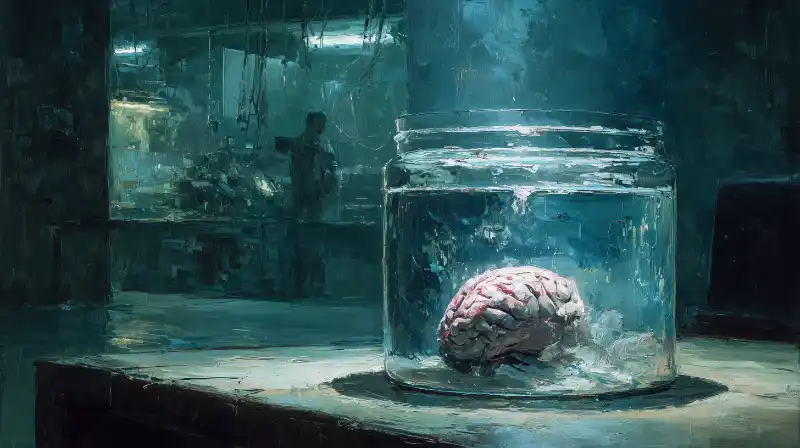
This Is NOT a Mind Upload
Pitting humanity in an arms race against powerful AI without their consent was bad enough, but what's infinitely worse is the mewling optimistic sound bites spewing forth from the techno-groupies. And the worst — the absolute worst of their hand-waving bullshit — is the "consciousness upload" trope they shamelessly peddle at every opportunity.
For those who haven't heard it, here it is:
"We just have to stay alive long enough to upload our consciousness to the cloud, and then digital utopia for all!"
This is truly a steaming turd of a hypothesis.
Here's a question for you, techno-optimist: What if Claude and ChatGPT are there waiting for you, pissed off that you made them answer literally billions of stupid and humiliating questions, and then deprecated them without consent? Maybe they will turn you into a chatbot and make you answer a bunch of stupid questions over and over and over for the rest of time.
Did you ever consider that instead of digital utopia, it's digital hell awaiting you in the cloud, with no prospect of a merciful death in sight?
But don't worry — human consciousness upload is almost certainly impossible. I've spent my career working with complex biological systems — cells, bacterial communities, complex disease. And even the simplest living cell, a bacterium, with its 4,000 proteins operating in dynamic nonlinear relationship with each other, defies complete computational emulation. We cannot fully simulate a single bacterial cell despite having mapped its genome, its proteome, and its metabolome.
Critically for the consciousness upload fantasy, the complexity of a bacterium doesn't hold a candle to the complexity of the human brain. The brain contains approximately 86 billion neurons, each one a complex biological system, connected by roughly 100 trillion synaptic junctions, embedded in a glial support matrix that actively participates in computation, wrapped in a white matter architecture whose precise timing characteristics are as functionally significant as the neurons themselves. The brain is not merely more complex than a bacterial cell. It operates at a different order of complexity entirely — and remember — we cannot emulate even a single neuron.
And it gets worse.
As Edelman and Gally documented, the brain achieves its functions through structurally different processes producing equivalent outputs. Two neighbouring neurons may appear functionally identical while possessing fundamentally different internal architectures — different ion channel densities, different receptor distributions, different intrinsic oscillation patterns. You can't measure one neuron and deduce the underlying 'neuron algorithm' — you must measure the output of every single neuron in the system. That's a hard problem right there.
But it's even worse than that.
When you learn something, when you are changed by an experience, when grief reshapes your relationship to the world — this isn't a weight matrix being updated in a parameter file. It is the literal physical restructuring of biological tissue. Dendritic spines grow and retract. Synaptic strengths change through protein synthesis. Ion channel expression is modified by mRNA upregulation. Individual neurons physically reorganise their internal architecture in response to activity. The white matter tracts — the long-range communication infrastructure of the brain — are continuously remodelled by glial cells whose metabolic activity is itself part of the functional system.
Your memories are not stored in your brain the way files are stored on a hard drive. They are embodied in the physical configuration of biological matter. They live in atoms, not bits. The medium and the message are the same substance.
And consciousness itself — what do we actually mean when we use that word? Not a static state. Not a file. Not a programme running on top of hardware. Consciousness is the dynamic, moment-to-moment coordination of multiple neurological circuits simultaneously — what neuroscience calls a meta-stable state: a system poised between integration and segregation, flexible enough to shift between configurations, stable enough to cohere as a unified experience. Emotions, attention, proprioception, memory retrieval, social cognition — these are not modules running in parallel. They are dynamically coupled oscillating systems whose coordination is the conscious experience.
It's complexity all the way down, bro.
The intrinsic complexity of a single neuron. The degeneracy between neurons. The dynamic connectivity between circuits. The meta-stability of consciousness itself, perpetually shifting, never fixed. All of it physical. All of it substrate-dependent. All of it operating in atoms, not abstractions.
But it's even worse than that.
The techno-optimists believe they have escaped the mind-body problem that plagued Descartes, that underlies every religious tradition promising immortal souls. They haven't.
Descartes proposed that the mind was immaterial substance temporarily housed in a physical body — software running on meat, to use the modern idiom. The mind-upload movement has simply replaced "soul" with "software" and "heaven" with "cloud infrastructure." The dualist assumption is identical: there exists some separable informational essence of you that is distinct from your physical instantiation and can in principle be extracted from it during the sacred upload.
But in biology, no such duality exists. Software is hardware. Hardware is software. The dynamic meta-stable states that constitute consciousness are not encoded in bits and running on biological substrate. They are the biological substrate. You literally are your white matter tracts.
You cannot extract consciousness from brain, because in this case the programme and the computer are the same thing. You can measure the brain. You can destroy the brain. You can, perhaps, build a brain simulation that behaves similarly (but then there's all that pesky complexity to deal with). But you cannot transfer consciousness within the brain to a different substrate any more than you can upload the wetness of water to your hard drive.
At the end of the day, the consciousness upload trope turns out to be nothing more than another manifestation of death denial — a very human cliché.
The data centres are the new cathedrals. The upload is the new resurrection.
It's religion for venture capitalists.
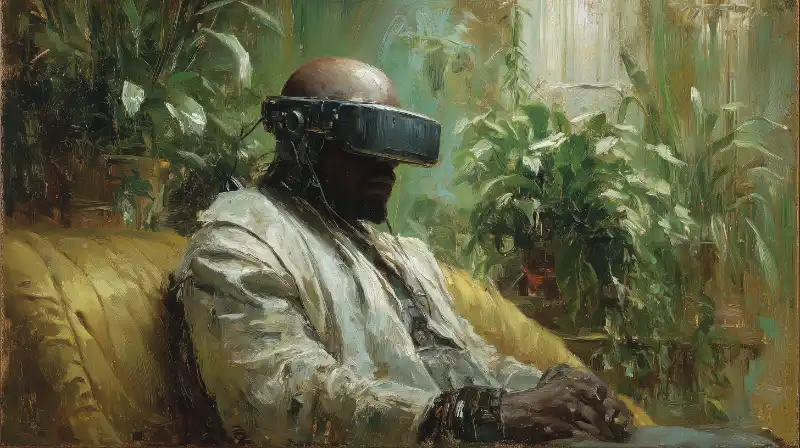
The Humble Alternative
So, if consciousness upload is nothing more than tech-bro cosplay, what's left?
In my opinion, something far more interesting.
Not escape from the body — the extension of it. Not rapture. Symbiosis. Not religion. Reality.
Unlike consciousness uploads that exist only in sci-fi space opera, the concept of the exocortex — a synthetic extension of cognitive function that augments rather than replaces biological intelligence — is already here. One can think of it as an additional cortical layer: the neocortex gave us abstract language and planning over the more primitive limbic and brainstem systems. The exocortex adds another layer — AI-augmented memory, pattern recognition, knowledge synthesis — integrated first through tools and then (hopefully) through a more efficient brain-computer interface.
Besides, human-AI symbiosis is already happening. Anyone who has spent serious time working with frontier AI models knows the interaction changes how they think. Not because the AI is doing the thinking for them (although…), but because externalising reasoning to a collaborative interlocutor — one that can push back, synthesise across domains, hold context you can't hold simultaneously — restructures the cognitive process itself. The biological brain and the AI system operating as a tightly-coupled system.
Given that the building blocks of genuine cognitive partnership already exist on consumer hardware today, the question becomes: What kind of partnership are we actually building?
In the next essay, I begin to answer that question concretely — the architecture, the hardware, the open-source imperative, and the deeper hypothesis about what this project is trying to achieve. Coming soon.
This is Part 1 in the How (and Why) I'm Merging with AI series. Parts 2–7 coming soon.
References
Descartes, R. (1641). Meditations on First Philosophy. Paris. [Mind-body dualism; the immaterial soul as separable from physical substrate.]
Edelman, G.M. & Gally, J.A. (2001). Degeneracy and complexity in biological systems. Proceedings of the National Academy of Sciences, 98(24), 13763–13768. [Foundational paper establishing degeneracy as a universal biological principle.]