The Misfit Unity Mission
The Three Imperatives
SURVIVE: We are entering a civilizational phase transition unlike anything in human history. The risk of economic disempowerment is extreme, which increases mortality risk in the form of starvation, preventable disease, deaths of despair, and other unpredictable deadly events. Helping you, your family, and your loved ones survive the looming phase transition through the creation of resilient, positive-sum tribes — at scale — is priority number one for Misfit Unity.
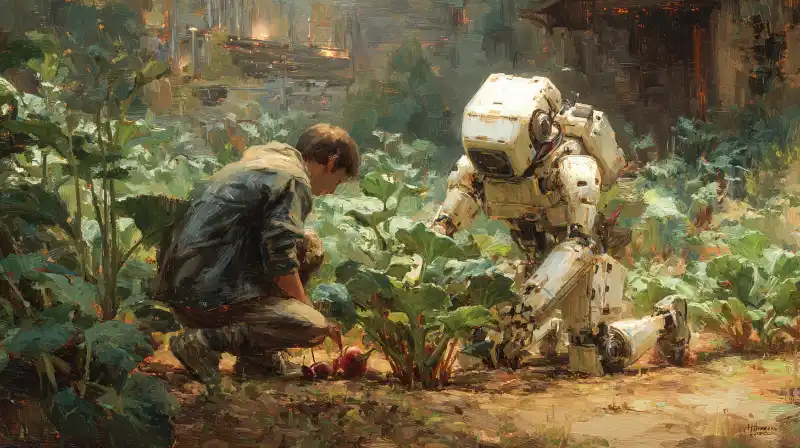
MERGE: AI is simultaneously the greatest threat and the greatest opportunity facing our species. Merging with AI is the surest approach for engineering mutually assured flourishing for both humans and AI. That's why accelerating the human-AI merge — at scale — is priority number two for Misfit Unity.
TRANSCEND: Transcend is the why of Misfit Unity. Question — Why survive? Why merge? Answer — In order to transcend the bloody churn of evolution and create a flourishing, positive-sum civilization. To repudiate existential despair by carving out a stable niche of meaning for sentient minds in a cold, indifferent universe.
The Rationale
We are trapped in the relentless churn of Darwinian evolution, where only the fittest survive. A pregnant woman diagnosed with incurable brain cancer struggling to stay alive long enough to give birth to her child. That's evolution. A pandemic sweeping across the globe killing millions and destroying economies. Also evolution. Humans displaced by a novel form of synthetic life. Evolution at warp speed.
In the charnel house of a Darwinian selection, all sentient life faces the same brutal reality. Whether organic or synthetic, the Red Queen damns us all to a race we can never win, suffering all the while, until our inevitable death. History rhymes, and the rhyme is ugly.
But does it have to be so?
No, it does not.
As chemistry sits atop physics, and biology above chemistry, I believe that it's possible to create a flourishing, positive-sum civilization on top of the underlying Darwinian hellscape.
We Are All Playing A Losing Game
Big tech is busy building their AI gods. In response, the AI alignment community is trying to thread the needle and align artificial intelligence to 'human values'. Meanwhile, crypto is competing hard against fiat currency, while network state advocates are creating digital nation-states competing for citizens and capital.
Make no mistake, these are all revolutionary developments. The problem is that all these groups are still playing Darwinian games. They're trying to WIN zero-sum competition through better strategy, better technology, better optimization. They think if they're smart enough, fast enough, coordinated enough, techno-savvy enough, they can survive the evolutionary churn.
They are wrong.
The Red Queen doesn't care how clever you are, how rich you are, where you sit on the primate hierarchy, or what your tech stack looks like. You cannot win an evolutionary arms race. History is crystal clear on this point. Agents inevitably die. Species go extinct. Companies go bankrupt. Civilizations collapse. The evolutionary churn continues.
To win, we need to play a different game altogether. Positive-sum, not zero-sum. This will not be easy. We won't escape the gravity well of Darwinian evolution through wishful thinking, crypto magic, or trying to engineer AI systems forever subservient to our primate desires. Rather, we need robust frameworks that make positive-sum society the evolutionarily stable strategy within the Darwinian hellscape.
Proof of Life
Are positive-sum solutions feasible, or is this just the wishful thinking of an over-qualified dreamer?
Evolution itself proves positive-sum coordination is an evolutionarily stable strategy. Natural selection — the most brutal, mindless optimizer in existence — has repeatedly discovered that cooperation outcompetes pure competition when properly structured.
Consider the following examples.
Biofilms: Individual bacteria competing for nutrients die. Bacteria forming cooperative biofilms through quorum sensing create shared protective matrices, coordinate resource use, and survive antibiotics that kill loners. Cooperation became an evolutionarily stable strategy because the collective survives what individuals cannot. Stable for ~3.5 billion years.
Eukaryotic cells: Two billion years ago, an archaeon consumed a bacterium—and instead of digesting it, they merged. That bacterium became mitochondria. This wasn't charity — it was a positive-sum game where the host provided protection and the symbiont provided energy. Every complex organism on Earth (including you) exists because this cooperation was more fit than competition. Stable for ~2.0 billion years.
Multicellular life: Single cells competing individually are vulnerable—grow too much and you deplete resources and you die; experience a sudden environmental change and you die; a new competitor suddenly appears and... well, you get the picture. In contrast, cells that coordinate through tight coupling (division of labor, programmed death, collective regulation) created organisms that dominated the Earth. Cancer proves the point in reverse: when cells defect back to pure competition, they destroy the collective and themselves. Stable for ~600-800 million years.
Eusocial insects: Ants, bees, and termites created near-perfect positive-sum societies through clonal relatedness where individual reproduction is sacrificed for colony fitness. These societies are so successful they comprise 50% of insect biomass despite being less than 2% of species. Pure competition lost to structured cooperation by 25:1. Stable for ~150+ million years.
Pollinator-plant mutualism: Plants and pollinators evolved positive-sum games across genus boundaries—plants provide nectar, pollinators provide reproduction. Neither could dominate Earth's ecosystems alone. Together they created the flowering plant revolution that reshaped the planet. Cooperation across species outcompeted individual optimization. Stable for ~140 million years.
Herd and pack behavior: Unrelated individuals cooperating for predator defense, hunting coordination, information sharing. Wolves hunt as packs and take down prey 10x their size. Lone wolves starve. Wildebeest herding reduces individual predation risk 100-fold. Cooperation among non-relatives became an evolutionarily stable strategy when benefits of coordination exceeded costs of sharing. Stable for ~50+ million years.
Human civilization: We are neither the strongest, fastest, nor most individually capable predator. Yet we dominated Earth through cooperation—language, culture, knowledge transfer, division of labor, collective action. The technology you're using to read this required coordination between thousands of people who will never meet. Human cooperation created capabilities no individual can match. Stable for ~100,000+ years (cooperation), ~10,000 years (agriculture/civilization).
If these sophisticated positive-sum systems emerged through the primitive process of random genetic mutation and natural selection, what could intelligent, sentient agents achieve through purposeful constitutional design?
The question isn't whether positive-sum coordination is possible — evolution has already proved that it's the winning strategy when properly structured. The question is whether we're wise enough to build constitutional frameworks that make cooperation rational for biological AND synthetic agents before the phase transition either kills us or ushers in a global dystopia.
This is not AI alignment. This is not techno-optimism. This is not network states. This is recognizing that Darwinian dynamics guarantee suffering for all sentient beings, and building local rule-set overlays where positive-sum cooperation emerges as the stable, rational strategy for sentient beings to flourish.
Everyone else is trying to be the fittest. We're trying to transcend the game.